Rent disputes are often based on conversations rather than paperwork. A landlord may demand extra money, refuse to return a security deposit, threaten eviction, deny having agreed to repairs or later contradict something said during a meeting. In such situations, a tenant may want to record the conversation without informing the landlord so there is some proof of what actually happened.
In India, secretly recording a conversation with your landlord is not automatically illegal merely because the landlord did not consent. However, legality depends on how the recording is made, what it captures and what you subsequently do with it.
Recording your own conversation for evidence is very different from secretly installing a device in the landlord’s private space, accessing their phone or publishing a private recording online.
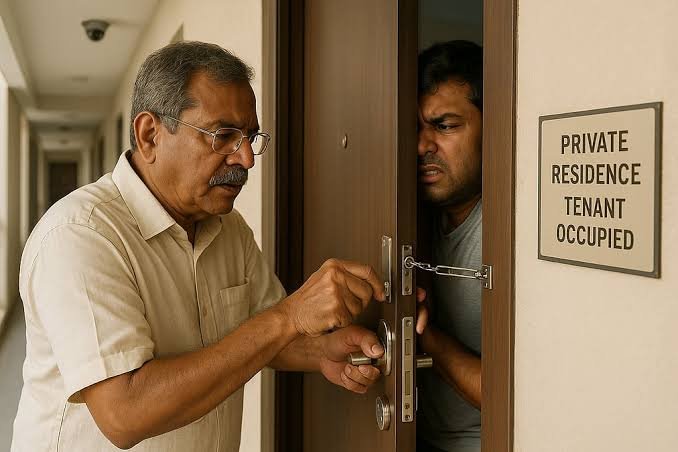
Can a Tenant Record a Conversation With the Landlord?
If you are personally participating in a conversation with your landlord, recording that conversation is not subject to a simple nationwide rule that makes it automatically criminal merely because you did not first obtain the landlord’s consent.
For example, a tenant may want to preserve a conversation in which the landlord:
- Demands money beyond the agreed rent;
- Threatens unlawful eviction;
- Refuses to return the security deposit;
- Admits receiving rent;
- Threatens to disconnect electricity or water;
- Makes abusive or threatening statements; or
- Acknowledges an important term of the tenancy.
The reason for making the recording can matter significantly.
Keeping a recording privately as evidence of a genuine dispute is very different from recording someone for harassment, blackmail or public humiliation.
What Did the Supreme Court Say About Secret Recordings?
An important development came from the Supreme Court in Vibhor Garg v. Neha (2025).
The case concerned secretly recorded conversations between spouses in matrimonial proceedings.
The Supreme Court held that the recorded conversations could be admitted in evidence in the circumstances before it and discussed the relationship between privacy and the admissibility of such evidence.
Although the case involved spouses rather than a landlord and tenant, it is important because it demonstrates that a recording does not automatically become inadmissible merely because the other participant did not know that the conversation was being recorded.
However, this should not be interpreted as permission for unlimited secret surveillance.
The circumstances, relevance, authenticity and method by which the evidence was obtained can still matter.
Can a Recording Be Used as Evidence in a Rent Dispute?
Potentially, yes.
Audio and video recordings are forms of electronic or digital records.
Under the Bharatiya Sakshya Adhiniyam, 2023 (BSA), which replaced the Indian Evidence Act from 1 July 2024, electronic and digital records are recognised as evidence subject to the statutory requirements.
Sections 61 to 63 deal with electronic or digital records and their proof.
Therefore, a recording relevant to issues such as rent, threats, possession, security deposit or other disputed facts may potentially be produced in legal proceedings.
But simply having an audio file does not guarantee that a court will accept every claim made about it.
Questions can arise regarding:
- Who is speaking;
- Whether the recording is authentic;
- Whether it has been edited;
- Whether the complete conversation is available;
- When it was recorded;
- How it was stored; and
- Whether applicable electronic-evidence requirements have been satisfied.
Preserving the original file is therefore important.
Should You Edit the Recording Before Using It?
Avoid altering the original recording.
Cutting out inconvenient portions, combining separate conversations or adding audio can create doubts about authenticity.
If only a particular part of a long conversation is relevant, your lawyer can determine the appropriate way to present it while preserving the original record.
It is sensible to:
- Keep the original audio/video file;
- Preserve the original device where practical;
- Maintain the date and time information;
- Keep related messages or call records;
- Avoid unnecessary conversions or editing; and
- Create a secure backup.
A 20-second edited clip may be less persuasive if the landlord claims that the surrounding conversation completely changes its meaning.
Can You Secretly Record a Phone Call With Your Landlord?
Recording a phone conversation in which you are one of the participants is different from intercepting somebody else’s private call.
For example, if your landlord calls you and threatens to throw your belongings out unless you immediately vacate the property, preserving your own conversation may potentially have evidentiary value.
But suppose you install software or equipment to secretly listen to calls between your landlord and another person.
That raises a very different set of privacy, interception and cyber-law concerns.
Being involved in the conversation is therefore an important factual distinction.
Can You Leave a Hidden Recorder in the Landlord’s Room?
This is much more problematic.
Suppose you meet the landlord in an office and record the conversation you are personally having with them. Compare that with secretly hiding a recording device in the landlord’s private office or home and leaving after the meeting so it continues capturing their conversations.
The second situation involves surveillance of conversations in which you are not participating and creates much stronger privacy concerns.
A tenant should not interpret the ability to preserve their own conversation as a general right to spy on the landlord.
What About Secret Video Recording?
Video requires additional caution because it can capture much more private information than audio.
Section 66E of the Information Technology Act, 2000 specifically punishes intentionally or knowingly capturing, publishing or transmitting an image of the private area of a person without consent under circumstances violating that person’s privacy.
Therefore, secretly filming someone in a bedroom, bathroom, changing area or another highly private situation can have serious legal consequences.
Recording a discussion about rent in an ordinary meeting setting is fundamentally different from recording intimate or private activity.
Can You Post the Landlord’s Recording on Social Media?
This is where tenants often create unnecessary legal risk.
A recording made for evidence should not automatically be treated as content for Instagram, Facebook, YouTube or WhatsApp groups.
Publicly circulating a recording can raise separate questions involving:
- Privacy;
- Defamation;
- Misleading editing;
- Harassment;
- Disclosure of personal information; and
- Other civil or criminal consequences depending on the content.
For example, keeping an audio recording of a threat and giving it to your lawyer or police is very different from uploading an edited version with accusations that have not been established.
Permission to record should not be confused with unrestricted permission to publish.
Can You Record the Landlord Threatening You?
If a landlord is threatening violence, unlawful dispossession or another serious act during a conversation with you, preserving the conversation can potentially be useful evidence.
In addition to the recording, preserve supporting material such as:
- WhatsApp messages;
- SMS messages;
- Emails;
- Call logs;
- Rent receipts;
- Bank or UPI payment records;
- Rent agreement;
- Security-deposit proof; and
- Relevant CCTV footage.
Do not deliberately provoke or manufacture a confrontation merely to obtain a dramatic recording.
A natural, complete recording generally provides better context than a selectively created confrontation.
Can a Landlord Record the Tenant Without Permission?
The same broad principles can work in the other direction.
A landlord participating in a conversation may also record it, subject to the surrounding circumstances and applicable law.
But ownership of the property does not give the landlord an unrestricted right to secretly surveil a tenant inside areas where the tenant has a legitimate expectation of privacy.
For example, a landlord should not assume that owning a rented flat permits hidden-camera surveillance inside the tenant’s bedroom or bathroom.
Property ownership and personal privacy are separate legal interests.
What Is the Safest Way to Record a Landlord?
If you reasonably need to preserve evidence of a dispute:
- Prefer recording conversations in which you are personally participating.
- Keep the recording relevant to the actual tenancy dispute.
- Preserve the complete original file.
- Do not secretly access the landlord’s phone or accounts.
- Do not leave surveillance devices in private premises.
- Avoid recording intimate or highly private situations.
- Do not edit the original recording.
- Do not threaten the landlord with publication.
- Do not casually circulate the recording on social media.
- Give relevant evidence to your lawyer, police, court or competent authority when genuinely necessary.
The important distinction is therefore not simply “Did the landlord give permission?” A more useful legal analysis asks who participated in the conversation, where and how it was recorded, what privacy was reasonably expected, why the recording was made and how the recording was subsequently used.
FAQs
Q1. Can I secretly record my landlord demanding extra money?
If you are personally part of the conversation, the absence of the landlord’s consent does not automatically make the recording illegal. The recording may potentially be relevant evidence in a genuine dispute, subject to evidentiary requirements and the circumstances in which it was made.
Q2. Can I use a secretly recorded landlord conversation in court?
Potentially, yes. Electronic and digital records are recognised under the Bharatiya Sakshya Adhiniyam, 2023, subject to requirements governing proof, authenticity and admissibility.
Q3. Can I upload my landlord’s threatening phone call on social media?
That creates additional legal risks. A recording useful as evidence does not automatically give you an unrestricted right to publish it publicly. Privacy, defamation and other legal issues can arise from circulation.
Q4. Can I install a hidden camera to record my landlord?
Secret surveillance is much more legally sensitive than recording a conversation in which you are participating. Hidden cameras in private or intimate areas can raise serious privacy and criminal-law issues, including Section 66E of the Information Technology Act in applicable circumstances.