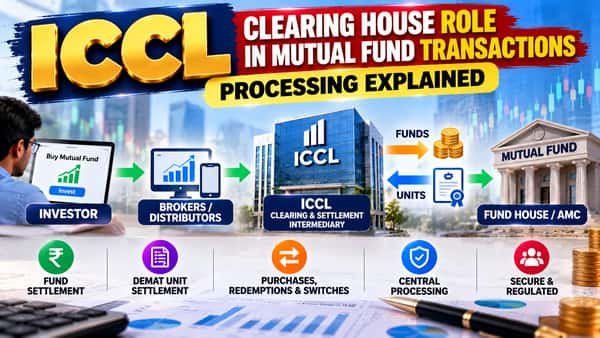
ICCL clearing house role in mutual fund transactions processing comes down to money and units: Indian Clearing Corporation Limited, BSE’s clearing arm, collects your payment, coordinates the movement of units through the depositories and pays redemption proceeds to your bank account for orders placed on the BSE StAR MF platform. It does not sit in your transaction when you invest directly through a fund house’s website or registrar. This is general information, not investment advice.
Quick Facts
| Item | What ICCL does |
|---|---|
| Platform | BSE StAR MF, used by distributors, brokers and other members |
| Orders covered | Purchase, redemption and switch, in demat or non-demat mode |
| Funds pay-in | Client money goes directly to ICCL’s bank account |
| Units in demat mode | Settled through CDSL and NSDL interfaces |
| Redemption pay-out | Credited by ICCL to the client’s bank account on the scheme’s settlement day |
| Parent | BSE Ltd, a wholly owned subsidiary since 2007 |
The Short Answer
ICCL is the middleman for money and units on one specific platform.
- ICCL’s own page says it functions as the clearing and settlement intermediary for purchase, redemption and switch transactions of mutual fund units placed by members on the BSE StAR MF platform
- The platform lets members place orders in either demat or non-demat mode, depending on the client’s choice, and ICCL settles both in the same settlement
- It uses a network of clearing banks and affiliations with financial aggregators to settle the funds side
Who ICCL Is
A clearing corporation tied to BSE.
- ICCL was incorporated in 2007 as a wholly owned subsidiary of BSE and carries out clearing, settlement, collateral management and risk management as a recognised clearing corporation
- In BSE’s equity and derivatives segments, ICCL acts as the central counterparty, interposing itself between buyer and seller through novation
- In the mutual fund and corporate debt segments, the description is of settling reported trades, which isn’t the same as guaranteeing them, according to a description of ICCL’s segments, so the central-counterparty protection of the equity market shouldn’t be assumed here
- Two rating agencies have rated ICCL AAA, according to one broker’s page, though that page is undated
How a Purchase Works
Money flows straight to ICCL.
- Participants must make sure client money for StAR MF transactions is credited directly into the bank account of “Indian Clearing Corporation Limited,” according to BSE’s master circular
- ICCL accepts funds only from client bank accounts registered on StAR MF, and if the amount is short of the order value, the order is rejected
- Payment options include net banking, UPI, RTGS or NEFT and cheques payable to ICCL, and one payment can match and settle multiple orders, according to a distributor’s guide
- Account numbers in that guide are from 2022 and may have changed, so use the details shown on your platform
Demat Versus Non-Demat
The unit side differs by mode.
- For units held in demat form, ICCL uses the interfaces of both CDSL and NSDL to settle purchases, redemptions and switches
- For a demat redemption, the units are delivered to ICCL’s demat pool account on the day the order is placed, with the quantity matching the order “till the last decimal,” according to ICCL
- Non-demat units are held in a folio with the fund house and settled through the fund-house route, though the page’s text on that route is cut off
- The platform needs a valid demat account registered for demat orders
How a Redemption Is Paid
The pay-out comes from ICCL.
- For demat redemptions, ICCL settles funds into the client’s settlement bank account on the scheme’s settlement day, known as the TAT day
- BSE’s circular says pay-out is credited to the bank account received in the order on StAR MF
- Non-demat redemption proceeds are credited by a different route, according to ICCL, which the available text doesn’t fully describe
- The settlement day depends on the scheme, so check its scheme document
Why Orders Can Stay Pending
Matching matters.
- Order processing remains pending if there’s a mismatch between the funds confirmation report and the respective orders, according to BSE’s circular
- A shortfall in funds leads to rejection, as above
- Unit quantity mismatches on demat redemptions can also hold up settlement
Pool Accounts and the 2022 Change
Rules about holding client money changed.
- CARE Ratings notes that the pooling mechanism in the mutual fund segment was discontinued with effect from July and October 2022, which required process changes at ICCL
- It says the change caused delays in settlement at the time
- That’s why today’s rule is direct crediting to ICCL, with no intermediary pooling of client money
Where ICCL Isn’t Involved
Not every mutual fund purchase touches it.
- It handles only transactions routed through the BSE StAR MF platform
- Investing directly through a fund house’s website or app or through a registrar’s channels doesn’t use ICCL, which is my inference from its description as the clearing intermediary for StAR MF
- Which route your platform uses is usually visible when the payment instruction names “Indian Clearing Corporation Limited”
Why It Matters to an Investor
A few practical consequences.
- Check that you pay only to ICCL, using the details on your platform, and never to an individual account
- Use the bank account registered on the platform, or the order may be rejected
- Keep the transaction reference, since it’s what you’d quote if funds or units go missing
Risks and Limits
Some limits are worth knowing.
- ICCL’s role is operational, so it doesn’t affect the NAV or returns of your fund
- Delays can arise from mismatches, bank issues or depository timing
- The source material I found is partly dated, so check BSE’s latest master circular for current procedures
FAQs
Q1. What does ICCL do in mutual fund transactions?
A. ICCL acts as a clearing and settlement intermediary for mutual fund purchases, redemptions, and switches placed through BSE StAR MF. It facilitates the settlement of funds and, where applicable, demat mutual fund units.
Q2. Do I pay money to the fund house or to ICCL?
A. For transactions processed through BSE StAR MF, client funds are credited directly to ICCL’s designated bank account, after which ICCL facilitates settlement with the mutual fund side.
Q3. Does ICCL guarantee my mutual fund trade?
A. ICCL’s central-counterparty role applies to specified BSE market segments such as equity and derivatives. For transactions through BSE StAR MF, ICCL functions as a settlement intermediary rather than providing the same type of trade guarantee.
Q4. How are demat redemption proceeds paid?
A. For eligible demat redemptions, ICCL credits the client’s registered bank account on the applicable scheme settlement day after the required units have been delivered to its designated pool account and the settlement requirements are completed.