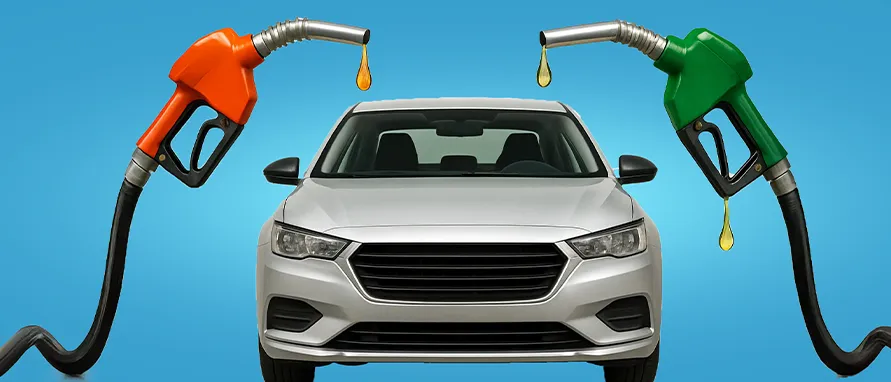
For a daily commuter, the petrol-versus-CNG decision becomes noticeable every time the odometer moves. Someone travelling only 15 km a day may appreciate the simplicity and performance of petrol. Someone covering 50–60 km every working day can save a meaningful amount each month by switching to CNG.
But running cost is only one part of the decision. CNG cars can involve a higher purchase price, reduced performance, limited fuel-station availability and, depending on the vehicle, compromises in boot space. Petrol cars are easier to refuel, generally more responsive and available with a much wider selection of automatic transmissions.
For Indian buyers, the better choice therefore depends on how far you drive every month, where you drive and what compromises you are willing to accept for lower fuel costs.
CNG Has the Big Advantage in Running Cost
This is the primary reason people buy CNG cars.
A CNG vehicle typically travels substantially farther per unit of fuel than its petrol equivalent, while CNG can also cost less than petrol depending on the city.
Consider the Maruti Suzuki Celerio. Maruti currently quotes approximately 26 km/l for petrol and 34.43 km/kg for CNG.
The Dzire provides another example. Its certified figures are 24.79 km/l for the petrol manual and 33.73 km/kg in CNG mode.
Real-world figures will naturally be lower or different depending on traffic, driving style, AC use and passenger load, but the potential running-cost advantage remains the biggest attraction of CNG.
Petrol Is More Convenient for Low-Mileage Users
Suppose your daily commute is only 10 km each way and you drive around 600–700 km per month.
Your fuel bill may not be large enough for CNG savings to transform your ownership costs.
Petrol then offers several practical advantages:
- Lower initial purchase price in comparable variants
- Wider model selection
- More automatic-transmission choices
- Better performance
- Easier refuelling
- No dependence on nearby CNG pumps
- Generally fewer luggage-space compromises
For someone driving relatively little, paying extra for a CNG version simply to reduce an already modest monthly fuel bill may take years to recover.
CNG Becomes Attractive for High Daily Mileage
Now consider someone travelling 60 km every working day.
Over 22 working days, that is approximately 1,320 km per month before adding weekend journeys.
At this usage level, even a ₹2 saving per kilometre would represent more than ₹2,600 per month.
The savings become increasingly meaningful for:
- Long-distance office commuters
- Sales professionals
- Business users
- Families with high monthly mileage
- Drivers regularly covering 1,500–2,000 km per month
This is why annual distance should be one of the first questions you answer before choosing the fuel.
Petrol Provides Better Performance
CNG contains different energy characteristics from petrol, and engines generally produce less power and torque when operating on CNG.
The Maruti Suzuki Ertiga provides a clear real-world example. Its 1.5-litre engine produces 75.8 kW and 136.8 Nm in the petrol Smart Hybrid version. In CNG mode, maximum output falls to 64.6 kW and 121.5 Nm.
That difference can become noticeable during:
- Quick overtaking
- Hill climbing
- Full-load acceleration
- Highway merging
- Driving with six or seven passengers
For relaxed city commuting, the reduction may not bother many owners.
If you enjoy strong acceleration or frequently drive a fully loaded vehicle on highways and hills, petrol can feel more effortless.
CNG Is Excellent for Stop-Start City Commuting
The performance trade-off is easier to accept when the vehicle spends most of its life in traffic.
In bumper-to-bumper conditions, maximum horsepower matters relatively little. Low running cost becomes much more noticeable because the car accumulates kilometres every day without travelling particularly quickly.
CNG technology is also becoming more sophisticated.
Maruti Suzuki’s latest factory CNG systems include Idle Start-Stop technology on applicable models, while its September 2026 introduction of automatic CNG versions of the Swift, Dzire and Baleno specifically targeted improved convenience in heavy traffic.
This is important because one of CNG’s traditional disadvantages has been limited automatic-transmission availability.
Petrol Still Offers More Automatic Choices
For daily city traffic, transmission choice can be just as important as fuel cost.
Constant clutch operation becomes tiring in congestion. Petrol cars provide a much broader selection of:
- AMT
- CVT/IVT
- Torque-converter automatic
- DCT
- Conventional manual transmissions
CNG has traditionally been dominated by manual gearboxes, although that situation is changing.
In September 2026, Maruti Suzuki introduced automatic S-CNG versions of the Swift, Dzire and Baleno using Auto Gear Shift technology.
That development makes CNG substantially more attractive to urban commuters who previously had to choose between low fuel costs and two-pedal convenience.
Still, if you specifically want a CVT, torque converter or DCT, petrol provides considerably more options.
What About Boot Space?
This has traditionally been one of CNG’s biggest compromises.
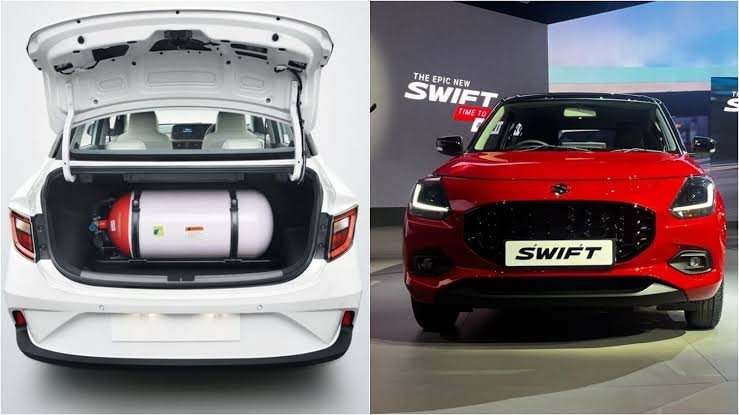
A conventional CNG cylinder is installed in the luggage compartment, reducing the space available for suitcases, shopping bags and other items.
For a daily office commuter carrying only a laptop bag, this may hardly matter.
For a family using the same car for holidays, it can become frustrating.
Manufacturers are beginning to address the problem through improved tank packaging. The latest Brezza S-CNG, for example, uses an underbody fuel-tank configuration designed to preserve boot space. It is rated at 26.9 km/kg.
Other manufacturers and models may use different packaging solutions, including dual-cylinder arrangements.
Therefore, do not assume every CNG car has an unusable boot. Physically inspect the exact vehicle you intend to buy.
Factory-Fitted CNG Is the Better Choice
If CNG is your preferred fuel, a factory-fitted system is generally the more reassuring option.
Factory CNG cars are engineered around the additional fuel system rather than having it added later.
Maruti Suzuki says its S-CNG vehicles use:
- Intelligent fuel injection
- Retuned suspension
- Stainless-steel pipes and joints
- Integrated wiring
- Leak-resistant CNG-system construction
- A microswitch preventing the vehicle from starting during refuelling
The company also says its CNG vehicles are evaluated for crashworthiness and durability with the CNG system installed.
Factory integration also means the manufacturer has accounted for the additional weight of the CNG equipment when calibrating relevant vehicle systems.
If you are buying a new car specifically to use CNG every day, choosing a factory-engineered version is generally preferable to installing an aftermarket kit simply to save on the initial purchase.
CNG Refuelling Requires More Planning
Petrol’s biggest everyday advantage may simply be convenience.
Petrol pumps are widely available, and refuelling normally takes only a few minutes.
CNG availability varies considerably by region. In cities with an extensive CNG network, ownership can be straightforward. In locations with fewer stations, owners may need to drive out of their way or occasionally wait in queues.
Before buying a CNG vehicle, check:
- CNG pumps near your home
- Stations near your workplace
- Pumps along your normal commute
- Availability on frequently used highways
- Typical queues during your travel hours
If refuelling adds 30 minutes to your routine every few days, some of the financial saving may feel less worthwhile.
Petrol Gives You Better Long-Distance Flexibility
A CNG car is not restricted to CNG.
Factory bi-fuel vehicles generally retain a petrol tank, allowing you to switch fuels when CNG is unavailable.
Maruti’s S-CNG technology, for example, provides automatic fuel changeover functionality between petrol and CNG.
That makes occasional highway trips perfectly practical.
However, someone who frequently travels to remote areas may still prefer petrol because finding petrol is easier and refuelling requires less route planning.
CNG makes the most sense when most of your kilometres occur within a predictable network of filling stations.
Which Is Better for Maintenance?
A normal petrol car has the advantage of a simpler fuel arrangement.
A CNG vehicle adds cylinders, high-pressure lines, valves and other dedicated components that require proper inspection and maintenance.
That does not mean factory CNG cars are unreliable. Modern factory systems are specifically engineered for CNG operation.
But owners should follow the manufacturer’s servicing instructions carefully and never ignore:
- CNG-system inspections
- Cylinder requirements
- Gas leaks or unusual smells
- Fuel-line condition
- Scheduled servicing
- Manufacturer instructions for petrol operation
Some manufacturer guidance also recommends maintaining petrol in the tank because a bi-fuel vehicle may need petrol during certain operating conditions.
Petrol vs CNG: Calculate the Break-Even Point
A CNG car usually costs more than an equivalent petrol version.
You can estimate whether that additional price makes financial sense with a simple calculation:
Extra CNG purchase price ÷ saving per kilometre = break-even distance
Suppose:
- CNG version costs ₹90,000 more
- CNG saves ₹2.50/km
Then:
₹90,000 ÷ ₹2.50 = 36,000 km
At 18,000 km per year, the difference could theoretically be recovered in approximately two years.
At 6,000 km annually, it could take around six years.
Actual calculations should use your local petrol and CNG prices plus realistic mileage for the specific car.
This is much more useful than saying CNG is always cheaper.
Petrol vs CNG: Which Is Better for Daily Driving?
For low-to-moderate daily mileage, petrol remains the simpler choice.
It offers stronger performance, easier refuelling, more transmission options and fewer concerns about luggage-space reduction. If you drive only 500–800 km each month, the additional cost of the CNG version may take a long time to recover.
CNG becomes increasingly attractive once daily mileage rises.
If you regularly cover 1,000–1,500 km or more per month, have convenient CNG stations nearby and prioritise running cost over maximum performance, a factory-fitted CNG car can make excellent financial sense.
A practical decision looks like this:
Choose petrol if your monthly mileage is low, you want stronger performance, regularly make unpredictable long-distance journeys or want the widest choice of automatic cars.
Choose CNG if your monthly mileage is high, fuel expenditure is a major concern, CNG pumps are convenient and you are comfortable with slightly lower performance.
For a high-mileage Indian city commuter, CNG can be one of the most economical combustion-engine choices available. For someone driving relatively little, petrol’s simplicity can easily be worth the additional fuel expense.
FAQs
Q1. Is CNG better than petrol for a daily office commute?
A. CNG can be better if your commute is long enough to generate meaningful fuel savings and you have convenient access to CNG stations. For short daily commutes and low monthly mileage, petrol may remain more practical.
Q2. Does a CNG car give less power than a petrol car?
A. Usually, yes. The same engine generally produces less power and torque in CNG mode. For example, the Ertiga produces 121.5 Nm in CNG mode compared with 136.8 Nm for the petrol Smart Hybrid version.
Q3. Can I drive a CNG car on petrol?
A. Yes. Factory bi-fuel CNG cars retain a petrol fuel system, allowing the vehicle to operate on petrol when required. This is useful when travelling through areas where CNG is unavailable.
Q4. Is CNG worth buying for only 500 km per month?
A. Usually, the financial case is weaker at such low mileage because fuel savings accumulate slowly while the CNG variant generally costs more initially. Compare the exact purchase-price difference and local fuel costs before deciding.