Two people can buy the same SUV and make completely different fuel choices for perfectly valid reasons. One drives 25 km a day through city traffic and makes occasional weekend trips. The other covers 2,000 km every month, much of it on highways with passengers and luggage. For the first buyer, petrol may be the sensible choice. For the second, diesel can still make financial and practical sense.
That is why the old rule that “diesel means better mileage, so diesel is better” is no longer enough for Indian car buyers. Modern BS6 diesel engines are more complex, petrol engines have become more efficient, fuel-price differences vary by state, and ownership restrictions deserve consideration in some regions.
In 2026, the decision should begin with your monthly kilometres and type of driving, not simply the price displayed at the fuel station.
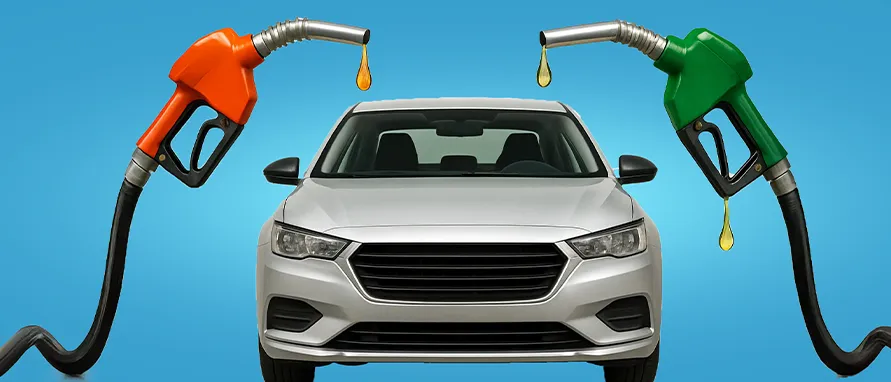
Petrol vs Diesel: The Basic Difference for a Buyer
A petrol engine is generally smoother, quieter and cheaper to purchase. It suits lower annual mileage and frequent city use particularly well.
A diesel engine normally produces stronger low-rpm torque and consumes less fuel over comparable distances. That makes it attractive for heavy vehicles, frequent highway driving and high annual mileage.
Hyundai’s current 2026 guidance similarly recommends petrol for predominantly city-based, modest-mileage use and diesel for buyers covering long highway distances every month.
The important point is that neither fuel is universally cheaper to own.
Petrol Cars Usually Cost Less to Buy
Purchase price is the first advantage of petrol.
When the same car is offered with comparable petrol and diesel engines, the diesel version commonly carries a premium because modern diesel engines require more sophisticated fuel-injection and emission-control technology.
Suppose:
- Petrol variant costs ₹15 lakh
- Comparable diesel variant costs ₹16.25 lakh
- Difference = ₹1.25 lakh
The diesel has to save at least ₹1.25 lakh through lower fuel consumption before it begins recovering that initial premium.
If you drive only 6,000–8,000 km annually, this can take a long time.
That is why buyers should calculate total ownership cost, rather than choosing diesel solely because its mileage figure is higher.
Diesel Generally Delivers Better Fuel Economy
Diesel engines remain attractive to high-mileage users because of their efficiency.
A comparable diesel SUV may travel noticeably farther on one litre than its petrol equivalent, particularly during steady highway cruising.
Diesel also has another advantage: low-end torque.
You can feel this when:
- Overtaking on highways
- Climbing hills
- Carrying six or seven passengers
- Driving a fully loaded SUV
- Accelerating without frequently revving the engine
This is one reason diesel engines remain particularly well suited to larger SUVs.
A buyer regularly making long intercity journeys may appreciate both the lower fuel consumption and relaxed pulling power.
But Fuel Price Alone Does Not Decide the Winner
As of 8 October 2026, PPAC lists the retail selling price at an IOCL outlet in Delhi at ₹102.12 per litre for petrol and ₹95.20 per litre for diesel.
That is a difference of only ₹6.92 per litre.
Fuel prices vary across India because of state taxes and other factors, so buyers should use prices applicable in their own city.
More importantly, compare cost per kilometre, not cost per litre.
For example, assume:
Petrol car
- Petrol: ₹102/litre
- Real-world mileage: 12 km/l
- Fuel cost: approximately ₹8.50/km
Diesel car
- Diesel: ₹95/litre
- Real-world mileage: 17 km/l
- Fuel cost: approximately ₹5.59/km
In this example, diesel saves roughly ₹2.91 per kilometre.
At 20,000 km per year, that becomes approximately ₹58,000 in annual fuel savings.
At only 5,000 km per year, the saving falls to around ₹14,500.
This is why annual mileage changes the calculation dramatically.
Petrol Is Usually Better for Short City Journeys
If your car spends most of its life travelling five or ten kilometres at a time, petrol is generally the easier choice.
Petrol engines warm up relatively quickly and are naturally well suited to frequent short-distance operation.
They are also generally:
- Quieter
- Smoother at idle
- Easier to operate in stop-start traffic
- Cheaper to purchase
- Mechanically less complicated in their emission-control systems
Hyundai’s current petrol-versus-diesel guidance specifically identifies petrol as suitable for short trips and city driving, while recommending diesel more strongly for high-mileage highway users.
For school runs, shopping and office commutes in dense traffic, petrol therefore remains a sensible default.
Modern Diesel Cars Do Not Love Endless Short Trips
This deserves particular attention with BS6 diesel vehicles.
Modern diesel engines use sophisticated emission-control equipment. Depending on the vehicle, this can include a Diesel Particulate Filter (DPF) and other systems designed to reduce harmful exhaust emissions.
The DPF captures soot and periodically needs sufficiently high exhaust temperatures to burn accumulated particles through regeneration.
A vehicle that repeatedly makes short, low-speed journeys may not always achieve the conditions required for effective regeneration.
That does not mean a diesel car cannot be driven in a city.
It means someone whose usage consists almost entirely of very short trips should carefully consider whether diesel is appropriate.
If your routine includes regular longer journeys where the engine reaches normal operating temperature, diesel becomes easier to justify.
Diesel Makes More Sense for High-Mileage Highway Drivers
Now consider someone driving 70–100 km every working day.
For this buyer, diesel starts making a much stronger argument.
High annual mileage means the fuel-efficiency advantage accumulates quickly, while regular highway operation suits the characteristics of modern diesel engines.
Diesel is particularly worth considering for:
- Highway commuters
- Intercity travellers
- Business users
- High-mileage SUV owners
- Families making frequent long trips
- People regularly carrying heavy loads
A strong diesel engine can also feel effortless in a large SUV because peak torque arrives relatively low in the rev range.
This is why the answer for a 2,000-km-per-month driver can be completely different from the answer for someone driving 500 km.
What About Maintenance Costs?
Petrol engines generally have the advantage in simplicity.
Modern diesel engines use expensive components such as high-pressure fuel-injection systems, turbochargers and sophisticated emission-control hardware.
Routine servicing does not necessarily make every diesel dramatically expensive, but an out-of-warranty failure involving certain components can cost more.
Potential diesel-related components include:
- Diesel particulate filter
- High-pressure injectors
- Turbocharger
- Emission-control sensors
- EGR-related components
- SCR/AdBlue system on applicable vehicles
Petrol engines can also use turbochargers, direct injection and complex electronics, so modern petrol cars are not mechanically basic either.
The better approach is to compare the actual maintenance schedule and warranty of the two variants you are considering.
Petrol Cars Are Better for Buyers With Low Annual Mileage
Imagine you drive approximately 700 km per month.
That works out to only 8,400 km annually.
Even if diesel saves ₹2–₹3 per kilometre in fuel, the annual saving may not be large enough to quickly recover a substantial diesel purchase premium.
You also carry the higher initial investment from day one.
For relatively low annual usage, therefore, petrol often makes more financial sense.
The money saved during purchase could instead be used for:
- A higher variant
- Automatic transmission
- Better safety equipment
- Extended warranty
- Insurance
- Accessories
- Several years of fuel
Do the calculation before paying more simply to obtain better mileage.
What Is the Diesel Break-Even Point?
There is no universal kilometre figure.
You can estimate it using:
Diesel purchase premium ÷ diesel fuel saving per kilometre = break-even kilometres
Suppose the diesel version costs ₹1.5 lakh extra and saves ₹2.50 per kilometre.
₹1,50,000 ÷ ₹2.50 = 60,000 km
You would need to travel roughly 60,000 km before fuel savings recover the additional purchase price, ignoring differences in maintenance, insurance, financing and resale value.
At 20,000 km annually, that is approximately three years.
At 8,000 km annually, it becomes around seven and a half years.
This calculation is far more useful than a generic statement such as “buy diesel above 1,000 km per month.”
Petrol vs Diesel for Large SUVs
Vehicle size changes the calculation.
A small petrol hatchback can be economical enough that diesel provides little reason to exist. This is one reason diesel engines have largely disappeared from India’s inexpensive small-car market.
Large SUVs are different.
A heavy SUV carrying several passengers requires considerably more energy to move. A diesel engine’s combination of fuel efficiency and low-rpm torque can work particularly well in these vehicles.
For buyers considering a large SUV for regular highway journeys, diesel deserves serious consideration.
For a compact SUV driven almost entirely in city traffic, petrol may still be the more logical option.
What About Driving Restrictions in Delhi-NCR?
Buyers in Delhi-NCR need to pay particular attention to regulatory developments.
Historically, diesel vehicles older than 10 years and petrol vehicles older than 15 years have faced end-of-life restrictions in NCR. However, the situation has been subject to recent court and regulatory developments.
In its October 2025 review, CAQM noted that the Supreme Court had directed that no coercive steps be taken solely because a diesel vehicle is 10 years old or a petrol vehicle is 15 years old, and CAQM consequently kept implementation of its related Direction No. 89 in abeyance until further orders.
At the same time, older CAQM documentation records the underlying 10-year diesel and 15-year petrol framework arising from NGT and Supreme Court directions.
Therefore, a Delhi-NCR buyer should check the current legal position at the time of purchase or resale rather than relying on old internet advice.
This issue can materially affect the long-term ownership calculation, especially if you plan to keep a vehicle for many years.
Which Has Better Resale Value?
There is no universal petrol-versus-diesel winner.
Resale depends on:
- City
- Vehicle segment
- Model popularity
- Age
- Mileage
- Condition
- Service history
- Local regulations
- Used-car demand
A diesel SUV can remain desirable in regions where buyers value highway efficiency and torque.
A petrol hatchback, sedan or compact SUV may have a broader audience among low-mileage urban buyers.
Regulatory uncertainty can also affect how much used buyers are willing to pay for older diesel vehicles in some markets.
Therefore, resale should be evaluated at the model and location level, not simply by fuel type.
Petrol vs Diesel: Which Should You Buy?
For most buyers doing predominantly city driving with relatively low annual mileage, petrol is the easier recommendation.
It generally costs less initially, operates smoothly in traffic and avoids some of the usage considerations associated with modern diesel emission-control systems.
Diesel remains highly relevant for the right buyer.
If you drive 15,000–20,000 km or more per year, spend significant time on highways and are purchasing a larger vehicle, its superior fuel economy and low-end torque can provide meaningful benefits. The exact break-even point should still be calculated for the models being compared.
A practical way to decide is:
Choose petrol if you drive relatively little, make frequent short journeys, primarily use the car in a city or want the lower initial purchase price.
Choose diesel if you cover high annual mileage, regularly undertake long highway journeys, need strong low-rpm pulling power or are buying a larger SUV that will frequently travel fully loaded.
And if your priority is extremely low running cost rather than either fuel specifically, it may also be worth comparing CNG, strong-hybrid and electric alternatives before making the final decision.
FAQs
Q1. Is it worth buying a diesel car in India in 2026?
A. Yes, for the right usage. Diesel remains attractive for high-mileage drivers, highway users and buyers of larger SUVs. For low-mileage city driving involving frequent short trips, petrol is generally easier to justify. Hyundai’s current guidance follows a similar distinction.
Q2. How many kilometres should I drive before choosing diesel?
A. There is no fixed number. Around 15,000–20,000 km annually can make diesel more attractive, but the actual answer depends on the price difference between petrol and diesel variants, their real-world mileage, local fuel prices, maintenance and planned ownership period. Calculate the break-even distance for the specific cars you are considering.
Q3. Which is cheaper to maintain: petrol or diesel?
A. Petrol cars are generally simpler and can be cheaper to maintain, particularly when comparing equivalent engines. Modern diesel vehicles have additional high-pressure fuel and emission-control equipment that can make certain repairs expensive outside warranty.
Q4. Which is better for a family SUV: petrol or diesel?
A. For a family SUV used mainly around the city and covering modest kilometres, petrol can be the better choice. For a larger SUV regularly carrying passengers on long highway journeys, diesel’s stronger low-rpm torque and better fuel economy can make it more suitable.