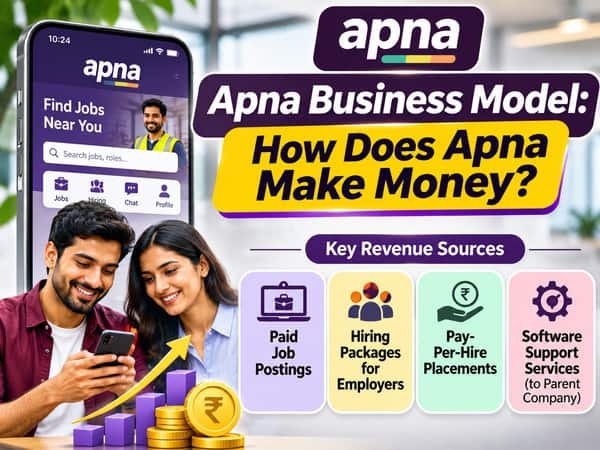
The Apna business model earns money mainly from employers, who pay for recruitment services such as job postings, hiring packages and pay-per-hire placements on its job platform for blue- and grey-collar workers, while job seekers use it free; it also books revenue from software development support it provides to its holding company. In FY25 it reported consolidated revenue of ₹144.1 crore and a net loss of about ₹50 crore. Some reports describe the revenue trend differently, which I’ve flagged.
Quick Facts
| Metric | FY24 | FY25 |
|---|---|---|
| Consolidated revenue | ₹139.8 crore | ₹144.1 crore, up 3.1% |
| Recruitment solutions revenue | ₹35.5 crore | ₹57.1 crore, up 61% |
| Total expenses | Not stated | About ₹194 crore |
| Net loss | ₹51.3 crore | About ₹50.1–50.2 crore |
| Estimated EBITDA | Not stated | About −₹34.6 crore |
| Business development spend | ₹18.5 crore | ₹20.8 crore |
The Short Answer
Apna is a two-sided job marketplace that charges the hiring side.
- Founded in 2019 by Nirmit Parikh, it initially positioned itself as a LinkedIn-like platform focused on hiring for blue- and grey-collar workers, according to Inc42
- Tracxn describes it as an AI-powered professional networking and job search platform connecting entry-level job seekers to employers, enabling candidate sourcing, job posting and automated matching
- Companies use a fee-based mechanism on the employer side to post job openings and access the applicant pool, according to StartupTalky
Where the Revenue Comes From
Inc42 says the startup earns revenue from two sources.
- Recruitment solutions: offered through its website and mobile app, which grew 61% to ₹57.1 crore in FY25 from ₹35.5 crore
- Software development support services to its holding company: the second source, according to the same report
- By my arithmetic, if those are the only two sources, about ₹87 crore, or roughly 60% of FY25 revenue, came from the holding-company services, though the report doesn’t state the split
- That means the marketplace business that most people think of is the smaller part of reported revenue
How Employers Pay
The employer side has several pricing routes.
- Job postings and premium services, such as promoting listings or accessing a larger pool of candidates, according to Vizologi
- Hiring packages and recruitment solutions, according to StartupTalky
- Pay-per-hire: revenue from this is recognised only after a candidate is placed and completes the required retention period, according to Inc42
- Pay-per-hire is a more outcome-linked model, which helps employers but delays revenue
Free for Job Seekers
Candidates don’t pay for the core product.
- Forbes India reported in 2021 that all jobs listed on Apna are verified and free for candidates
- Parikh said then that the long-term monetisation would come “when people are doing interviews,” and that the company had only run pilots
- A Vizologi page says the platform is free for job seekers and employers and charges employers for premium services, which is partly contradictory, so check the current pricing on the site
The Numbers
Growth is slow, and the loss is steady.
- Consolidated net loss narrowed 2.3% to about ₹50.1 crore from ₹51.3 crore, according to Inc42
- Total expenses rose to ₹194 crore, and net margin was about −35%, according to Inc42’s financial page
- Inc42’s company page says revenue grew 3.1%, while the article headline says “revenue dips” and that the top line dropped, so I couldn’t reconcile the direction
- One profile lists earlier losses of about ₹120 crore, but I couldn’t confirm which years those apply to
Where the Money Goes
The costs are mostly people and marketing.
- Business development expenses were ₹20.8 crore, up from ₹18.5 crore
- Acquiring both job seekers and employers is the main cost of running a marketplace
- Total expenses of ₹194 crore against revenue of ₹144 crore explain the loss
Funding and Status
Apna is a well-funded unicorn.
- It has raised about $193 million across five rounds, according to Inc42
- It became a unicorn in 2021, according to Forbes India, which described it as one of the fastest in India with almost zero annual revenue
- In 2023, it partnered with the Labour Ministry to list jobs on the National Career Service and with DPIIT to boost hiring across startups, according to Inc42
Product Direction
The company has added AI.
- Apna entered voice AI with BlueMachines.ai in October 2025, and reported fast enterprise AI adoption, according to Entrackr
- AI-driven recommendation and lead generation workflows are part of its platform, according to Tracxn
- A 2021 article described a marketplace, a professional social network and an upskilling business as three separate lines, though I found no current revenue for upskilling
Where the Sources Disagree
A few details differ.
- Revenue direction in FY25, as described above
- Whether employers pay at all for basic postings
- Co-founders: Tracxn lists Aryan Kenchin alongside Nirmit Parikh
- Check the Registrar of Companies filings for the entity you’re interested in, since consolidated and standalone figures can differ
Risks
The model has weak spots.
- Heavy reliance on related-party services for a large share of reported revenue
- Slow growth in marketplace revenue relative to expenses
- Competition from Naukri, Internshala and others, according to Inc42
- Pay-per-hire revenue depends on retention periods and placement quality
FAQs
Q1. How does Apna make money?
A. By charging employers for job postings, hiring packages and pay-per-hire placements, plus revenue from software support services to its holding company.
Q2. What was Apna’s FY25 revenue?
A. ₹144.1 crore consolidated, up 3.1% according to Inc42’s profile, though one article describes the top line as dropping.
Q3. Is Apna profitable?
A. No. It reported a net loss of about ₹50.1 crore in FY25, narrowing slightly from ₹51.3 crore.
Q4. Is Apna free for job seekers?
A. Core job search has been free for candidates, with employers paying for premium services and hiring solutions.