The living room wall conversation in Indian home design has shifted considerably in what it considers a baseline. A decade ago, a painted wall in a carefully chosen color was a design decision. Now, with the range of surface materials available and the visual reference points that people bring to renovation conversations from social media, travel, and design content, a painted wall is increasingly the starting point rather than the outcome. The expectation has moved, and the materials available to meet it have moved with it.
What contemporary living room wall design is reaching for, in most of the conversations happening around it in Indian homes right now, is a surface that has physical quality rather than applied decoration. The difference is in whether the wall reads as having depth and material presence or whether it reads as a flat background that happens to have something on it. Texture, shadow, material warmth, and the way a surface interacts with light are the qualities that create the first kind of wall, and most of them cannot be achieved through paint alone.
Wall Solutions Organized by What They Do Best
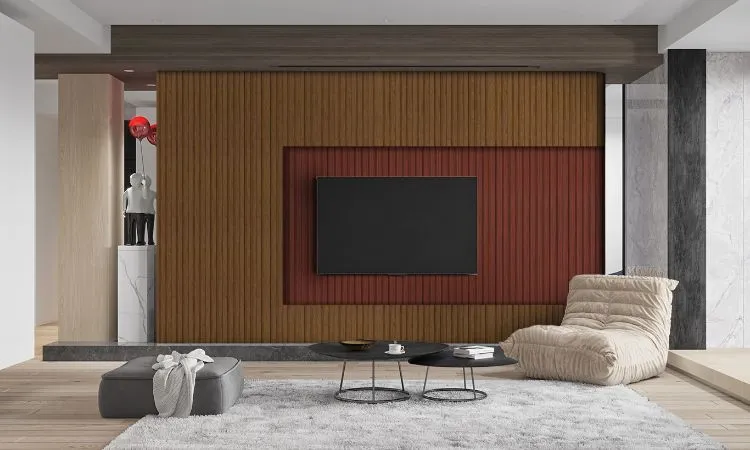
Fluted and vertical panel surfaces are the strongest current direction in contemporary living room wall design, and their prevalence reflects a real quality rather than a passing moment. The reason a fluted panel surface works in a living room is specific: the vertical lines it creates draw the eye upward, which makes a room feel taller than it is, and the shadow between the ridges gives the surface a depth that changes throughout the day as the angle of light shifts. In a living room where much of the furniture is horizontal and low, a vertical surface treatment provides a counterpoint that improves the room’s proportions without requiring structural change.
Vertical louver panels in wood-grain or neutral solid finishes are the version of this direction that appears most often in contemporary Indian living rooms, and the combination of the louver profile with a warm timber tone is one of those pairings that works across a wide range of other color and material choices in the room. You can look through what this direction looks like across different finish options through this page on vertical louvers design, which covers the range of profiles and finishes available and how they are typically applied in living room contexts.
Stone-effect wall panels have expanded well beyond bathroom and kitchen applications and now appear on living room feature walls, entrance zones, and behind fireplaces and console units with some consistency. The appeal is the visual weight and richness that stone brings to a surface without the structural implications of actual stone cladding. A UV-finished stone-look panel on a living room accent wall creates a surface that reads as a premium material choice at a fraction of the cost and weight of the real thing, and with significantly lower maintenance over time.
For the television wall specifically, a combination of recessed shelving with a material-finished back panel produces a result that is both functional and visually coherent. The back of a shelving unit in a contrasting or complementary surface material, laminate in a stone-effect or a dark matte solid, makes the objects on the shelf read more clearly and gives the wall a designed quality that a simple painted wall behind open shelving does not have. The full range of laminate options available for this application covers both the aesthetic directions and the practical finish qualities that a living room environment requires.
Layering Materials Without Losing Coherence
The strongest contemporary living room wall solutions tend to combine two materials rather than one, and the combination that works most consistently is a textured or panel surface on the feature wall paired with a painted or plain-finished surface on the surrounding walls. This keeps the visual interest focused rather than distributed, which is what allows the featured surface to read clearly rather than competing with everything around it.
The transition between two different wall materials is worth thinking about as carefully as the materials themselves. A clean division at an internal corner, a thin metal or timber reveal strip between two surfaces, or a panel frame that contains one material within a defined area and separates it from the adjacent surface are all ways of managing the transition in a way that reads as intentional rather than improvised. Material changes that run into each other without a clear transition tend to make even well-chosen materials look unfinished.